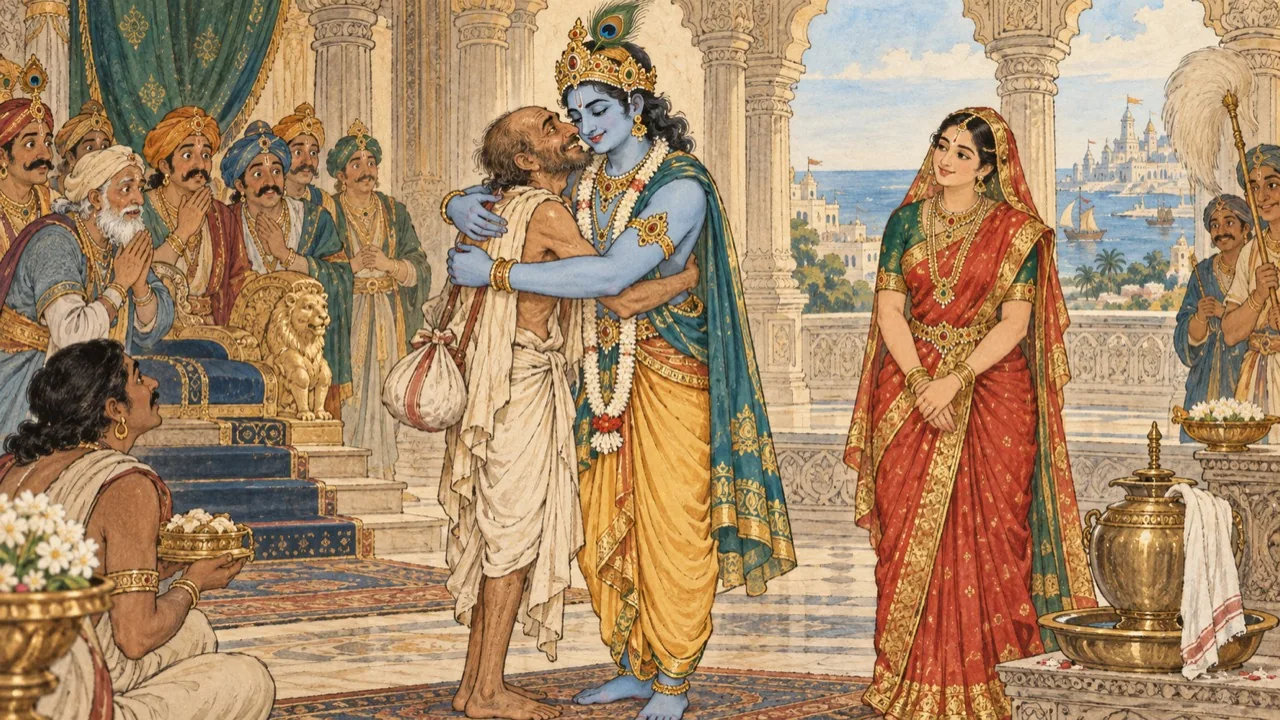
There was barely enough rice for the children in Sudama’s house that day. The roof shifted in the wind, and when rain came they lined the floor with bowls. Yet whenever Sudama spoke of his old gurukula days, the room filled with light. One evening his wife, Susheela, asked, “Your childhood friend Krishna lives in Dwaraka. Why not visit him?” Sudama shook his head. “I cannot turn friendship into a door at which I ask for a loan.” Susheela answered gently, “I am not asking you to beg. I am asking you to meet your friend without hiding your hardship. There is dignity in allowing a true friend to see you as you are.”
Sudama would not arrive empty-handed. Susheela borrowed a little flattened rice from a neighbor and tied it in a clean piece of worn cloth. Sudama felt ashamed when he saw the tiny bundle. Was this a gift for the king of Dwaraka? He hid it beneath his shawl as he walked. But the farther he travelled, the more clearly he remembered the gurukula: the day they gathered firewood in a storm, the night they shared food while hungry, the moments when each protected the other after some boyish mistake. Krishna had not been a king then. He had been the boy who laughed beside him. The memory made Sudama’s steps lighter.
A QUIET PAUSE
Why is the small bundle so difficult for Sudama to offer?
There is no right answer. Notice what the story brings up for you.
At the palace gate, guards looked doubtfully at the visitor in worn clothes. “Tell him Sudama from Sandipani’s gurukula has come,” he said. The message went inside, and then the court saw something astonishing. Krishna left the assembly and ran to the gate. He called Sudama by name and embraced him. He washed his friend’s feet with his own hands and seated him nearby. One by one, the watching faces changed; the courtiers began to see the person behind the torn cloth. Krishna did not begin by asking about money. He laughed and said, “Do you remember how you pretended to sleep when our teacher woke us before sunrise?”
Lost in conversation, Sudama continued to hide the rice bundle. Krishna noticed and pulled it free with the delight of a child. “Will you hide from me what you brought for me?” He untied the cloth and lifted the flattened rice as though it were a priceless feast. When Krishna ate the first handful, Sudama’s shame dissolved. As he reached for another, Rukmini gently stopped his hand and smiled. “For one handful of such love, you would give away all three worlds.” The court laughed without mockery. Sudama remembered the words he had prepared about poverty, yet he no longer wished to recite them. To have his small gift received without embarrassment already felt like a blessing.
A QUIET PAUSE
What protects Sudama's dignity most in Krishna's welcome?
There is no right answer. Notice what the story brings up for you.
The next morning Sudama began his journey home. Krishna had placed no gold in his hands, and Sudama had asked for nothing. For a moment on the road he worried, “What will I tell the children?” Then another thought steadied him: Krishna had not hidden him from the court, treated his poverty as disgrace, or called his gift too small. When Sudama reached home, a comfortable house stood where the old hut had been. Susheela came out in good clothes, but her gaze had not changed. “Did you ask him?” she said. Sudama shook his head. “No. Yet my friend heard everything that needed to be heard.”
Sudama cleared the debts and arranged for the children to study. Susheela first visited the neighbour and repaid the borrowed rice. A few days later, a traveller drenched by rain stopped at their door. Sudama’s young daughter ran to the kitchen and returned with flattened rice tied in a clean, worn cloth. “It is only a little,” she said. Sudama received the bundle in both hands. “For someone on the road, it may be much.” After the meal, he folded the cloth and kept it beside the first little bundle Krishna had opened.